
SUSTAINABILITY| 10.24.2025
The climate countdown enters a critical phase


In November, COP30, the major global climate summit, will be held in Belém, in the heart of the Brazilian Amazon. Nearly 200 countries will meet to review the progress of the Paris Agreement, set new emission reduction commitments for 2035, and strengthen climate financing mechanisms. The summit comes after 2024, the hottest year on record, with the climate safety threshold on the verge of being surpassed.

The worsening of the climate crisis is now convincing, unfortunately, even the most skeptical. They may deny or question its causes, which is deeply problematic, but everyone recognizes that summer heat is becoming increasingly unbearable and the violence of weather events ever more extreme.
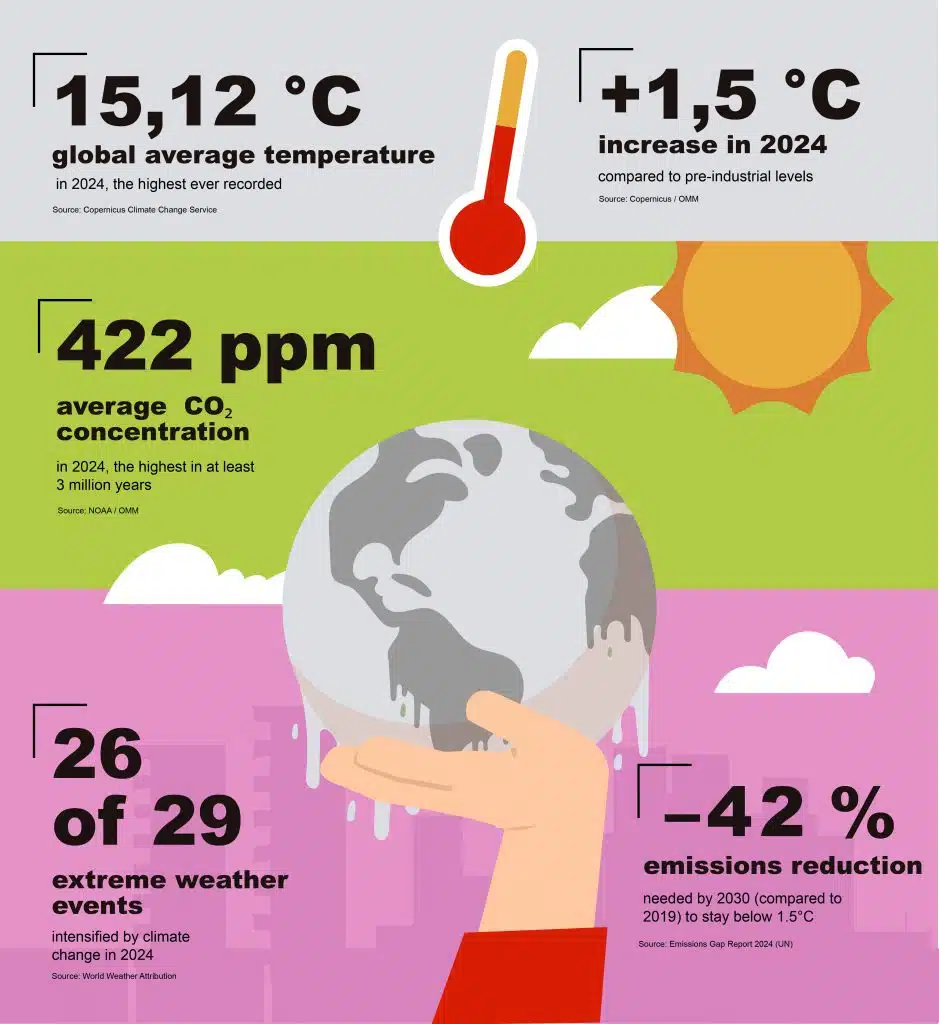
From November 10 to 21, COP30 will take place in Brazil, where participating countries will assess the status of agreements and commitments aimed at curbing climate change. The situation is concerning. The year 2024 closed as the warmest on record, with a global average temperature of 15.12 °C. This value represents an increase of approximately 1.5 °C compared to pre-industrial levels, the threshold set in the Paris Agreement as a critical limit to avoid the most dangerous effects of climate change. In addition, the atmospheric concentration of carbon dioxide also reached a new record, with an average of 422 parts per million (ppm), which represents an increase of more than 50% compared to the levels of 1750. This is the highest level in at least three million years, according to data from the NOAA and the World Meteorological Organization.
The effects of warming are lethal. A study published last year by the international network of scientists World Weather Attribution concluded that climate change intensified the ten deadliest extreme weather events recorded worldwide over the past two decades, which claimed at least 576,042 lives. This explains the persistent heat waves, the devastating floods caused by storms in southeastern Spain and Central Europe, and Category 5 hurricanes such as Beryl, Helene, and Milton, which severely affected the east coast of the United States and several countries in Central America.
Climate change is no longer a future threat: in 2024, 26 of the 29 extreme weather events analyzed by scientists were directly intensified by human action.
The latest UN Emissions Gap Report (2024) warns that unless climate ambition is significantly increased in the next round of reduction commitments, the possibility of keeping global warming below 1.5 °C will vanish within a few years. According to the same report, global emissions would need to be reduced by 42% by 2030 (compared to 2019 levels) and by 57% by 2035 to stay within that limit. However, current policies remain far from achieving those targets.
It is true that renewable energies are being used more and more. During 2024, electricity generation from clean sources once again set records on a global scale, according to data from the Ember Global Electricity Review and the report from the International Energy Agency (IEA). In many countries, new renewable installations are already cheaper than operating coal or gas thermal power plants, which has accelerated the energy transition even in the absence of subsidies. Despite this, the use of fossil fuels continues to grow in many emerging economies, especially in countries like India, Indonesia, and the Philippines.
Eyes on Brazil
The celebration of COP30 in Belém, in the heart of the Brazilian Amazon, has a symbolic weight. This territory contains 20% of the world’s freshwater and a quarter of terrestrial biodiversity. It also functions as a natural carbon sink, absorbing millions of tons of CO₂ each year, and regulates essential rain patterns not only for South America but also for other regions of the planet. This area is today seriously threatened by deforestation, illegal mining, arson, agricultural expansion, and megaprojects in infrastructure. At some points, scientists warn that it could be close to a point of no return, where it would cease to be a tropical forest and transform into a savanna, releasing more carbon than it can store.
In this context, we at MAPFRE will actively participate in the conference as part of our environmental commitment and our role as a key player in climate risk management. One of the highlights will be the presentation of the report Climate Change and the Insurance Industry, which we prepared at MAPFRE Economics. In it, we analyze the losses caused by extreme weather events, insurance protection gaps, the role of reinsurance, and protection mechanisms such as disaster bonds.
In the financial field, investors are increasingly adopting ESG criteria, with ambitious goals to enhance the sustainability of their portfolios in the coming years.
All of this is part of our Corporate Sustainability Plan, which sets clear goals to advance in decarbonization and in a more sustainable and fair economic model. As detailed in our Sustainability Report, we are making steady progress in our climate commitments and in sustainability. By the close of 2024, we have managed to neutralize our carbon footprint in 10 countries, with the aim of expanding that figure to 15 between 2024 and 2026. Currently, we have offices in Spain, Mexico, Italy, the Dominican Republic, Peru, and Malta, all of which already operate with self-consumption energy systems using solar panels.
In the financial field, 90.2% of our investment portfolio is rated under ESG criteria (environmental, social, and governance), with the commitment to reach 95% by 2026. In addition, at least half of the new savings and investment products will be sustainable.
Operationally, we have reduced our carbon footprint by 25% compared to 2022 and remain committed to achieving a 30% reduction by 2030, with the ultimate goal of reaching net-zero emissions by 2050. Currently, 80.50% of electricity consumption at MAPFRE comes from renewable energy sources.
Antonio Huertas, MAPFRE CEO, emphasized that “environmental commitment is about steadily and progressively raising sustainability standards, supporting society through a just energy transition with a strong social focus.” We will also reflect this approach in the meetings we will hold with employees, experts, and other stakeholders during COP.
By participating in COP30, we reaffirm our commitment to support companies, individuals, and communities in a climate transformation process that is fair, viable, and socially inclusive. Because the future will be sustainable, or there will be no future.
RELATED ARTICLES:

SUSTAINABILITY | 04.09.2023How can we combat climate change?"We must find a way to harmonize the economic system of our era with the delicate ecosystem of nature.” Luis Prieto,...

SUSTAINABILITY| 16.11.2021 “It is essential to define scenarios and develop predictive models to prevent and mitigate the effects of climate change” Mónica Zuleta, MAPFRE’s Group Head of...

SUSTAINABILITY| 19.04.2021 Curbing climate change, the great battle waged by businesses around the world [maco_author author="user_13" _builder_version="4.4.8" custom_margin="16px||||false|false" custom_margin_tablet="40px||||false|false" custom_margin_phone=""...