
SUSTAINABILITY | 11.04.2025
Cultivating talent from within: continuous learning as the key to business transformation

Professional development is not just a matter of talent or personal initiative. For professionals to grow, they need an environment that makes it possible—one that fosters a corporate culture promoting continuous learning as a tool for transformation.

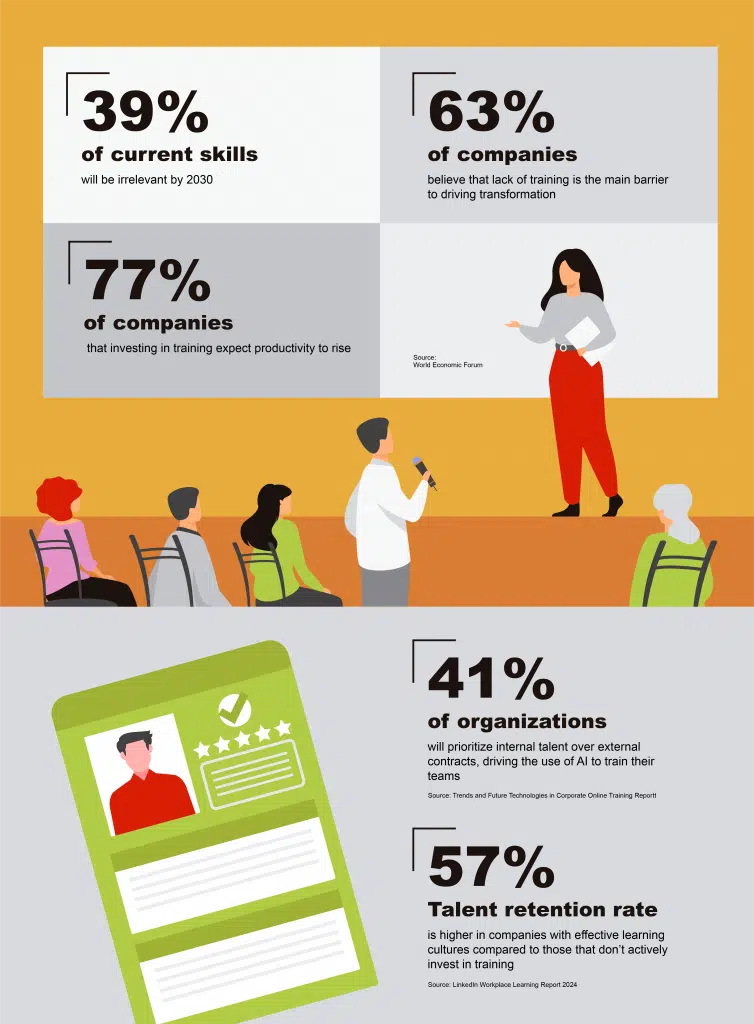
In a global scenario where 59% of employees will need to re-skill before 2030, according to the World Economic Forum’s Future of Work Report 2025, continuous training is no longer an extra but a requirement for the future of professionals. Digital skills, analytical thinking, resilience, emotional intelligence, and the ability to learn will be even more valued than specific technical knowledge. In this scenario of accelerated change, the workplace is also changing, and it is no longer enough to offer stability or good remuneration, as new generations of employees seek spaces where they can grow, contribute, and develop. As Benjamin Franklin once said, “An investment in knowledge pays the best interest.” When a company invests in the development of its teams, the returns multiply with greater commitment, more autonomy, better ideas, and a more motivated workforce. Ultimately, a trained person not only works better but also relates better to their environment, makes more conscious decisions, and finds deeper meaning in what they do.
Training for adaptation
Professionals who work in environments that promote continuous learning acquire new skills and show higher levels of satisfaction, commitment, and sense of belonging. According to LinkedIn Learning, 94% of employees say they would be willing to stay longer at a company that actively invests in their professional development. That is because they feel more prepared to face challenges, as they can better adapt to changes in the environment. Continuous training allows professionals to stay up-to-date with technological advancements, respond quickly to market transformations, and improve their performance in complicated tasks. In addition, at an emotional level, it also contributes to increasing self-confidence, motivation, and psychological well-being, as feeling that one is making progress is one of the most powerful keys to strengthening the bond between the person and their work. In this context, organizations that bet on an active learning culture are better prepared to face the future, as they have more versatile teams aligned with the strategic objectives of the company.
Ninety-four percent of employees state that they would be willing to stay longer in a company that actively invests in their professional development
More and more companies are recognizing this potential and are transforming their culture to make learning accessible to everyone, regardless of their role, experience, or where they work. Digitalization has opened new doors, allowing millions of people to access personalized, flexible, and relevant training content from anywhere in the world and at their own pace. Promoting an inclusive culture of continuous training not only empowers professionals within the organization, but also strengthens diversity, improves internal cohesion, and multiplies collective growth opportunities.
An investment that multiplies
Continuous learning benefits those who receive it, but it also transforms the company. In fact, according to Forbes, when companies offer comprehensive training programs, they achieve 218% more revenue per employee than companies without formal training. Furthermore, by investing in the development of its teams, an organization gains flexibility, reduces its internal gaps, improves its ability to attract talent, and enhances innovation from within. According to the Workplace Learning Report 2024 by LinkedIn, companies with effective learning cultures achieve retention rates up to 57% higher and promote greater internal mobility exceeding 23%. This demonstrates how continuous learning strengthens teams, improves results, and positions companies as benchmarks in their sector. And many times the best ideas arise from accumulated knowledge, shared experience, and a genuine desire to evolve. A trained and motivated person has more tools to contribute to the development of their team, to face complex challenges, and to lead from a position of responsibility.
Companies that offer comprehensive training programs generate 218% more revenue per employee than companies without formal training
At MAPFRE, we believe that professional growth should be available to everyone, regardless of their location, age, or role. That is why we have designed a Global Learning Model that integrates technology, pedagogy, and innovation with the sole objective of supporting all employees in their development. This model offers updated, accessible, and multi-format content that adapts to the interests and trajectories of each person. As we highlighted in our latest People and Organization Report, during 2024, this commitment translated into more than one million hours of training delivered globally, where 100% of the workforce participated in some training activity, with an average of 34.62 hours of training per person. In addition, the company has strengthened accessibility through the global online training platform, available in multiple languages and adapted to multiple devices, allowing each person to learn from anywhere in the world, at the time that best suits their needs. The online content catalog has been reinforced with access to external platforms, offering a variety of additional training resources that complement accessibility efforts and personalization. This has fostered self-development and collaborative learning, encouraging both the exchange of knowledge among colleagues and the design of individual learning pathways. In this context, the MAPFRE Corporate University, which celebrated its tenth anniversary in 2024, has been a fundamental pillar in consolidating this learning model, becoming a benchmark for innovation and excellence in training for our employees.
At the same time, and in line with our commitment to sustainability and active participation in the Conferences of the Parties (COP), we have launched a specialized training program for professionals in actuarial, risk, investment and other key areas, aimed at raising awareness and promoting the mitigation of potential negative impacts arising from the climate and industrial transition. This initiative saw the attendance of 1,347 employees.
Looking to the future
Impending technological, demographic, and climate changes will force us to reinvent many of the labor models that we know today. According to the World Economic Forum, more than 40% of the skills required to perform future jobs will need to be updated in the coming years. This scenario presents a challenge, but also as a great opportunity, since each transformation brings new ways of collaborating and new paths to grow. In that context, continuous learning becomes an essential tool for advancement, and the commitment of professionals and companies will be fundamental to adapt to the needs of the professions of the future.
RELATED ARTICLES:

SUSTAINABILITY | 02.10.2025Carlos Eduardo: “Young talent cultivates new ideas and offers innovative solutions to transform society”In a constantly evolving context, companies...

INSURANCE | 09.05.2024Insurance: a talent-rich industry with much to offerAt first glance, the insurance industry might seem less appealing than other sectors, but it's...

SUSTAINABILITY| 05.27.2024 “Intergenerational experience is essential for nurturing talent” Fostering a ‘proaging’ culture that promotes coexistence and...